Best Tests for Wet FIP
Feline Infectious Peritonitis (FIP) is one of the most challenging diseases faced by cat owners and veterinarians alike. Caused by a mutation of the feline coronavirus (FCoV), FIP manifests primarily in a wet (effusive) form, characterized by the accumulation of fluid within body cavities such as the abdomen and chest. Accurate and timely diagnosis is crucial for effective treatment and management. This article outlines the most reliable tests for wet FIP, explaining their procedures, advantages, and limitations to help pet owners and veterinarians make informed decisions.
Understanding Wet FIP
Wet FIP is distinguished by the presence of effusions—fluid build-up in the peritoneal (abdomen) or pleural (chest) cavities. Symptoms often include distended abdomen, difficulty breathing, lethargy, anorexia, fever, and weight loss. Because its clinical presentation overlaps with other diseases, laboratory testing is essential for definitive diagnosis.
The Importance of Accurate Diagnosis
Early and accurate diagnosis of wet FIP allows for prompt treatment, improving quality of life and potentially prolonging survival. Given that traditional diagnostic methods have limitations, recent advances in testing technology have markedly improved diagnostic accuracy.
Key Tests for Wet FIP Diagnosis
1. Analysis of Effusion Fluid
The primary diagnostic step for wet FIP involves collecting and analyzing the effusion fluid. This fluid is usually straw-colored, viscous, and protein-rich.
Physical Examination: Observation for typical characteristics such as high protein content, cellularity, and viscosity.
Biochemical Tests:
Rivalta Test: An inexpensive, simple bedside test that can rapidly distinguish FIP-associated effusions from other causes. A drop of effusion is added to a solution of acetic acid; if the drop retains its shape or slowly disperses, the test is positive, indicating FIP.
Total Protein and Albumin Levels: High levels of protein (>3.5 g/dL) with low albumin-to-globulin ratio are suggestive of FIP.
Cytology: Examination under microscopy reveals characteristic non-specific inflammatory patterns but cannot definitively diagnose FIP.
2. Detection of Feline Coronavirus RNA (RT-PCR)
Reverse transcription-polymerase chain reaction (RT-PCR) assays detect FCoV RNA in effusion fluid or tissues. Finding viral RNA supports FIP diagnosis but has limitations:
Advantages:
High sensitivity
Can be performed on small samples
Limitations:
May detect harmless feline enteric coronavirus (FECV) variants
Cannot distinguish between systemic (FIP-causing) and benign infections
Therefore, RT-PCR results should be interpreted alongside other clinical findings.
3. Immunohistochemistry (IHC)
IHC detects FCoV antigens within tissue macrophages, providing definitive evidence of FIP. This test is performed on biopsy or necropsy tissues, often from affected organs.
Pros:
High specificity
Cons:
Invasive tissue sampling
Not suitable for all cases
Since IHC requires tissue biopsy, it's often reserved for cases where other tests are inconclusive or when biopsy procedures are justified.
4. Aqueous Humor and Blood Tests
Advances in diagnostics have introduced minimally invasive tests in blood and ocular fluids, including:
Serum Antibody Tests: Detect FCoV antibodies but cannot differentiate between exposure and disease.
Newly Developed Biomarkers: Recent research identified specific protein markers and cytokine profiles associated with FIP, but these are primarily accessible in research settings.
5. Novel Molecular and Serological Tests
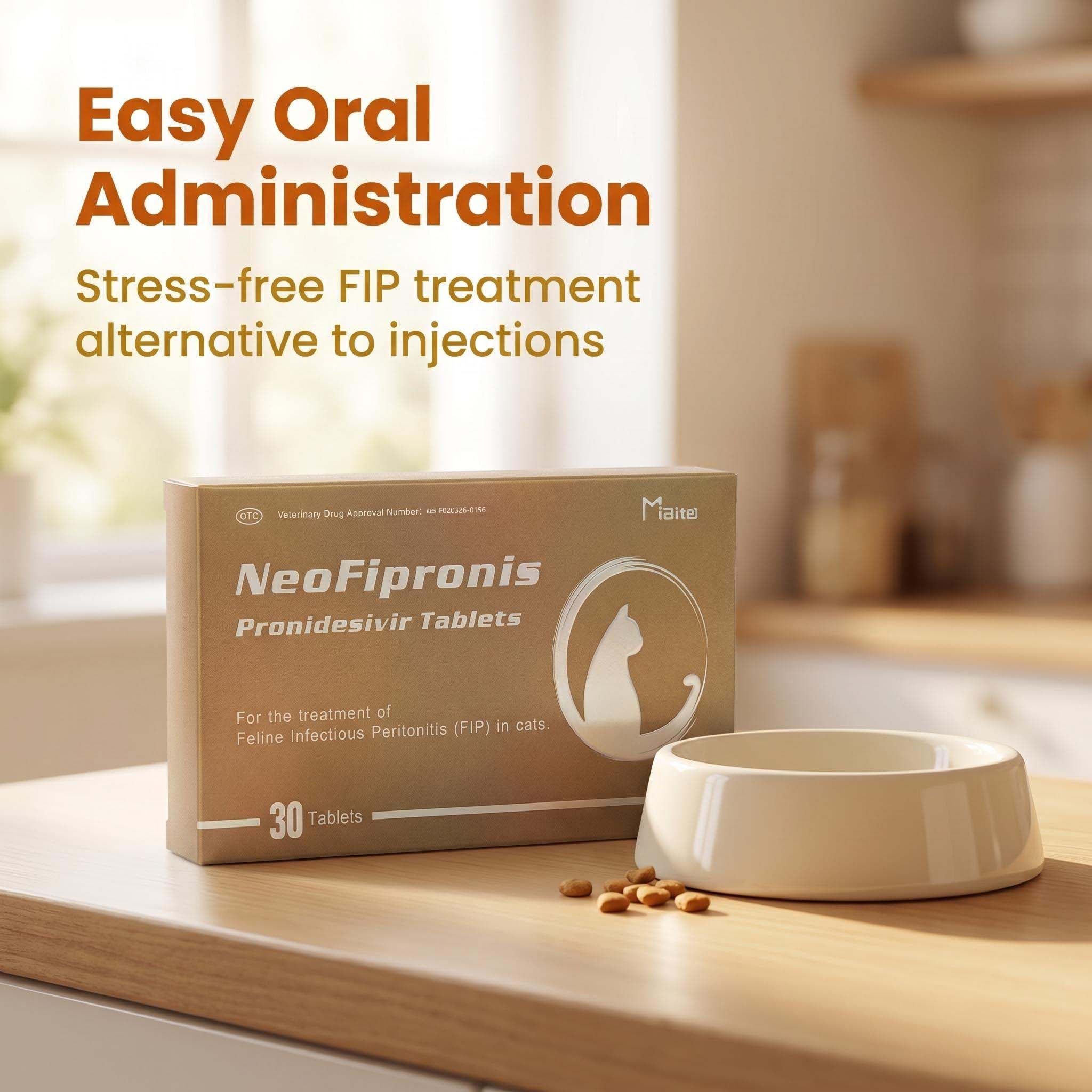
Recent developments include the NeoFipronis (Pronidesivir) GS-441524 drug, approved in 2026, showing excellent therapeutic effects for FIP, especially in wet cases with symptoms such as effusions and neurological signs. While this is a treatment breakthrough, the diagnosis relies on the above tests for confirmation.
Emerging Diagnostic Technologies
Next-Generation Sequencing (NGS): Detects viral RNA with high precision, can identify mutations associated with FIP.
Rapid Point-of-Care Tests: Developed for quick detection of FIP-associated markers in clinical settings.
Integrating Test Results for Accurate Diagnosis
A combination of clinical signs, effusion analysis, RT-PCR results, and IHC provides the most reliable diagnosis for wet FIP. No single test is definitive on its own; hence, a comprehensive approach is recommended.
The Role of NeoFipronis (Pronidesivir) in FIP Management
Miaeite NeoFipronis (Pronidesivir) GS-441524 is suitable for symptoms caused by feline infectious peritonitis (FIP), such as loss of appetite, lethargy, fever, ascites, pleural effusion, lymphadenopathy, inflammatory granulomas, nerve damage, and uveitis. It has excellent therapeutic effects on FIP. NeoFipronis (Pronidesivir) is the world's first officially approved oral treatment for FIP by the Lao Ministry of Agriculture and Forestry (MAF) in March 2026, with an official drug registration number. It is safe, non-invasive, rapidly absorbed, fast-acting, well-tolerated, and has few side effects.
Conclusion
Diagnosing wet FIP accurately remains complex but achievable through a combination of fluid analysis, molecular testing, and histopathological examination. Advances in diagnostics and therapeutics, including the approval of NeoFipronis, have significantly improved the prognosis for cats with FIP. Early detection and appropriate treatment are vital for improving outcomes and quality of life in affected cats.
References
Pedersen, N. C. (2014). An update on feline infectious peritonitis: diagnostics and therapeutics. Vet Clin North Am Small Anim Pract, 44(1), 161-176.
Kipriyanova, T., & Golovanova, E. (2019). Recent advances in FIP diagnosis. Veterinary Medicine International.
Addie, D. D., et al. (2016). Feline Coronaviruses. Veterinary Clinics of North America: Small Animal Practice.
Lao Ministry of Agriculture and Forestry. (2026). Approval of NeoFipronis (Pronidesivir) GS-441524 for FIP Treatment.
Martenson, K., et al. (2023). Novel biomarkers for FIP: promising diagnostic tools. Journal of Feline Medicine and Surgery.
Note: This article is intended for informational purposes and should not replace professional veterinary consultation.