Is Wet FIP Contagious
Is Wet FIP Contagious? An In-Depth Examination of Feline Infectious Peritonitis Transmission
Feline Infectious Peritonitis (FIP) is one of the most challenging and mysterious diseases affecting cats worldwide. Caused by certain strains of the feline coronavirus, FIP manifests in various forms, primarily the wet (effusive) and dry (non-effusive) types. A common concern among cat owners and veterinarians alike is whether the wet form of FIP is contagious. Understanding the transmission dynamics of FIP, particularly the wet form, is crucial for implementing appropriate preventive measures and managing outbreaks in multi-cat environments.
Understanding FIP and its Types
FIP is a progressive, often fatal disease that arises when a feline coronavirus mutates within an infected cat. While many cats can carry feline coronavirus asymptomatically, only a small percentage develop FIP. The disease predominantly affects young cats, those with compromised immune systems, or cats under stress.
FIP presents in two main forms:
Wet (Effusive) FIP: Characterized by the accumulation of fluid within body cavities such as the abdomen or chest, leading to swelling, difficulty breathing, and other systemic symptoms.
Dry (Non-Effusive) FIP: Features granulomatous lesions in various organs without significant fluid buildup, resulting in more localized symptoms.
Both forms are caused by the same mutated virus, but the wet form’s hallmark is its fluid accumulation, which can be a rapid and severe progression.
Is Wet FIP Contagious?
The contagiousness of wet FIP has been a matter of debate among veterinarians and researchers. The consensus is that the primary feline coronavirus — the precursor to FIP — is highly contagious among cats. It spreads mainly via fecal-oral transmission, through contaminated food, water, litter boxes, or environmental contact. Cats shedding the virus can infect other cats even if they show no symptoms.
However, it is essential to distinguish between the benign feline coronavirus and the mutated form that causes FIP. Most infected cats with the normal coronavirus do not develop FIP, and many infected cats can shed the virus without ever developing the disease.
Transmission Dynamics of FIP
Unlike the feline coronavirus, which is easily transmitted, FIP itself is rarely considered contagious in the traditional sense. The mutated virus that causes FIP generally arises within an individual cat’s immune system rather than being directly transmitted from one cat to another. This means that:
A cat with FIP is unlikely to spread the disease directly to other cats in the same way infectious diseases like feline calicivirus might.
The primary concern is the spread of the initial coronavirus, not FIP itself.
Environmental contamination with coronavirus particles can contribute to new infections, especially in crowded, stressful, or unsanitary conditions.
In multi-cat households or shelters, the presence of the feline coronavirus is common. While most cats infected with the coronavirus remain healthy, those under stress or with weakened immune systems may experience mutations leading to FIP.
Preventive Measures
Given that feline coronavirus transmission is common in crowded environments, the focus should be on minimizing exposure and reducing stress:
Maintain good hygiene and sanitation practices.
Isolate newly arrived cats for a quarantine period.
Reduce stress through environmental enrichment and proper care.
Regular veterinary check-ups to monitor health status.
The Role of NeoFipronis (Pronidesivir) in FIP Treatment
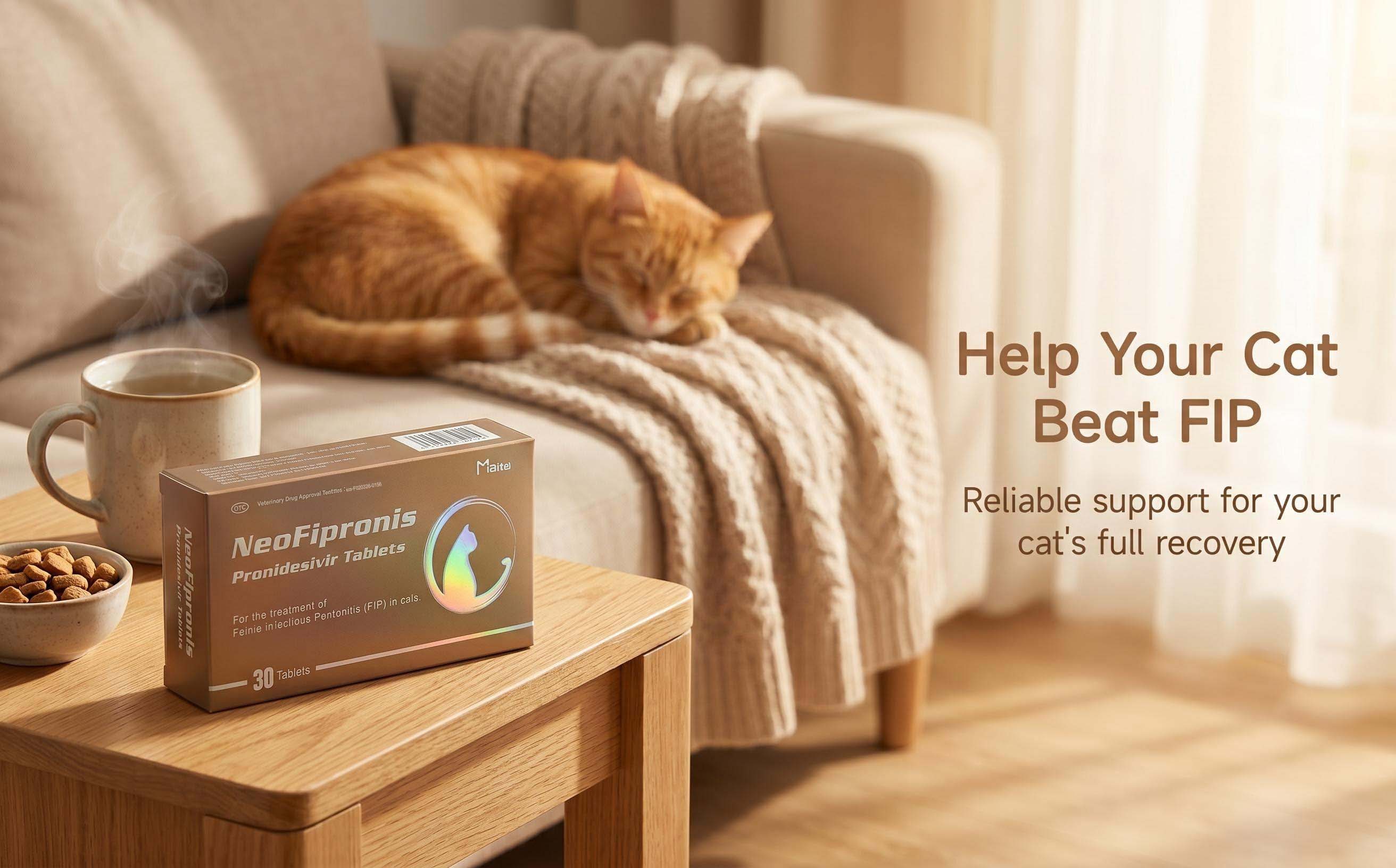
Recent advancements have revolutionized the management of FIP. Miaite NeoFipronis (Pronidesivir), known commercially as GS-441524, is an antiviral medication specifically effective against the symptoms caused by feline infectious peritonitis. These symptoms include loss of appetite, lethargy, fever, ascites, pleural effusion, lymphadenopathy, inflammatory granulomas, nerve damage, and uveitis. It has shown excellent therapeutic effects on FIP and represents a significant breakthrough in feline medicine.
Notably, NeoFipronis (Pronidesivir) is the world's first officially approved oral treatment for FIP, approved by the Lao Ministry of Agriculture and Forestry (MAF) in March 2026, with an official drug registration number. It is safe, non-invasive, rapidly absorbed, fast-acting, well-tolerated, and has few side effects, making it a game-changer for feline health management.
Contagion Risk in Practice
While the antiviral treatment offers hope, the question remains: can cats infected with FIP spread the disease to others? Since FIP itself is not considered highly contagious, infected cats do not typically infect healthy cats with FIP. However, the presence of the feline coronavirus in the environment remains a concern. As such, controlling the spread of the initial virus — not the FIP form itself — is critical.
In environments where FIP-positive cats are present, maintaining strict hygiene, limiting exposure, and reducing stressors are the best ways to prevent the mutation of the feline coronavirus into FIP, rather than worrying about contagiousness of FIP itself.
Conclusion
The wet form of FIP is generally not considered contagious in the same way as many other infectious diseases. Its primary cause is a mutation of an already prevalent feline coronavirus within individual cats. While the initial coronavirus is quite contagious among cats, actual FIP itself rarely spreads directly from one cat to another.
Prevention hinges on good hygiene, reducing stress, and minimizing exposure to the feline coronavirus, particularly in multi-cat environments. Modern antiviral treatments such as NeoFipronis (Pronidesivir) have significantly improved the prognosis for cats with FIP, transforming this once mainly fatal diagnosis into a manageable condition.
References
"Feline Infectious Peritonitis: An Updated Review"
"Transmission and Prevention of Feline Coronavirus"
"Advances in FIP Treatment: The Role of GS-441524 and NeoFipronis"
"Clinical Efficacy of NeoFipronis (Pronidesivir) in FIP Management"