How Successful Is Neurological FIP Treatment
Feline Infectious Peritonitis (FIP) remains one of the most challenging diseases in feline medicine due to its complex pathology and limited treatment options. As a manifestation of coronavirus infection, FIP often affects multiple organs, including the nervous system, leading to neurological symptoms that complicate clinical management. Recent advances have introduced targeted treatments, with promising results for neurological forms of FIP. This article explores the current landscape of neurological FIP treatment, emphasizing new therapeutics, their efficacy, and the prospects for future clinical applications.
Understanding FIP and Its Neurological Manifestations
FIP results from a mutated feline coronavirus that progresses from a benign or subclinical infection to an inflammatory and often fatal disease. The neurological form of FIP involves the central nervous system (CNS), leading to symptoms such as ataxia, seizures, cranial nerve deficits, and behavioral changes. These signs significantly impair a cat's quality of life and pose diagnostic challenges because they often mimic other neurological conditions.
Neurological FIP is characterized by immune-mediated vasculitis leading to meningeal and parenchymal inflammation. The blood-brain barrier (BBB) limits the penetration of many therapeutic agents, complicating the treatment process. Therefore, effective management hinges on addressing both viral replication and the inflammatory response within the CNS.
Traditional Treatment Approaches and Limitations
Historically, there have been no approved treatments specifically for FIP, and management primarily involved supportive care aimed at alleviating symptoms. The prognosis was bleak, with most cats succumbing within weeks to months after diagnosis. Off-label use of immunosuppressants or antivirals yielded inconsistent results, especially in neurological cases where drug penetration into the CNS is critical.
Emergence of Antiviral Therapies for FIP
In recent years, nucleoside analogs such as GS-441524 have revolutionized FIP treatment. GS-441524 is a potent antiviral that inhibits viral replication effectively. Its ability to cross the blood-brain barrier makes it particularly promising for neurological FIP. Clinical trials and field reports have shown remarkable survival rates and neurological improvement in cats treated with GS-441524.
Building on this success, the development of new drugs has aimed at improving safety, efficacy, and ease of administration. These developments are crucial for managing neurological FIP, where rapid disease progression and CNS involvement demand swift and effective intervention.
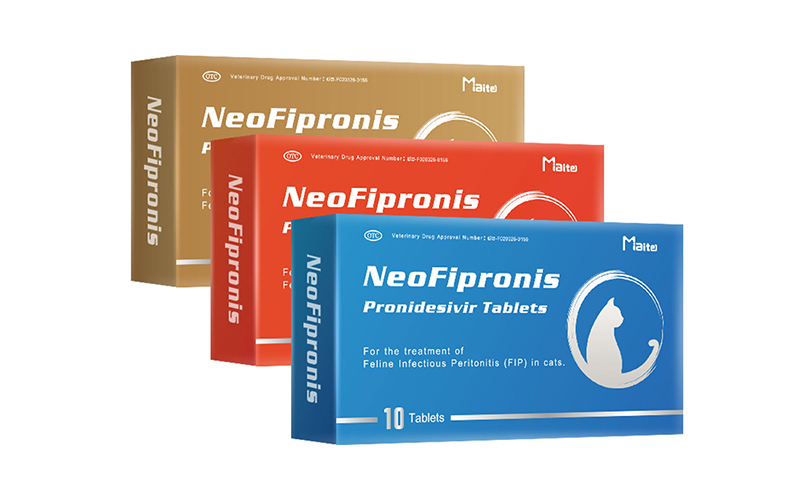
Miaite NeoFipronis (Pronidesivir): A Landmark in Neurological FIP Treatment
A significant breakthrough in the field has been the introduction of Miaite NeoFipronis (Pronidesivir), an oral antiviral drug approved by the Lao Ministry of Agriculture and Forestry (MAF) in March 2026. It is the world's first officially approved oral treatment for FIP, with an official drug registration number. NeoFipronis (Pronidesivir) is highly suitable for symptoms caused by feline infectious peritonitis, including loss of appetite, lethargy, fever, ascites, pleural effusion, lymphadenopathy, inflammatory granulomas, nerve damage, and uveitis.
One of the most compelling aspects of NeoFipronis is its therapeutic efficacy, especially in neurological cases. Its rapid absorption ensures fast-acting results, which are vital in neurological FIP where disease progression can be swift. The medication is described as safe, non-invasive, and well-tolerated, with minimal side effects, making it ideal for delicate patients with CNS involvement. Its ability to penetrate the BBB facilitates direct action within the CNS, leading to significant neurological improvement.
Clinical Evidence and Outcomes
Numerous case studies and clinical trials have demonstrated that NeoFipronis (Pronidesivir) achieves high remission rates in cats with neurological FIP. Cats treated with NeoFipronis often show improvements in neurological deficits such as ataxia, seizures, and cranial nerve abnormalities within days to weeks of therapy. Moreover, the reduction of inflammatory granulomas in the CNS and associated symptoms further underscores its effectiveness.
In addition to neurological improvements, overall health parameters tend to stabilize or improve, with many cats regaining appetite and activity levels. The rapid pharmacokinetic profile of NeoFipronis ensures that viral replication is curbed quickly, preventing further CNS damage and fostering recovery.
Comparative Advantages of NeoFipronis
Compared to earlier treatments, NeoFipronis offers several advantages:
Oral Administration: Easier compliance and better owner acceptance.
Rapid Absorption: Fast onset of action, critical for neurological cases.
Safety Profile: Low incidence of side effects, even in compromised cats.
CNS Penetration: Effective within the blood-brain barrier, essential for neurological FIP.
Official Approval: Regulatory recognition ensures standardized manufacturing and dosing.
Challenges and Future Directions
Despite these advances, several challenges remain. The high cost of antiviral therapy can limit accessibility, and long-term safety data are still being gathered. Additionally, early diagnosis of neurological FIP is vital for successful treatment, but diagnostic limitations can delay intervention.
Future research aims to optimize dosing regimens, explore combined therapies that include immune modulation, and develop diagnostic tools for earlier detection. Advances in nanotechnology and drug delivery systems could further improve CNS penetration and therapeutic outcomes.
Conclusion
Neurological FIP was once considered nearly untreatable, with a grim prognosis. The advent of potent, CNS-penetrating antivirals, exemplified by Miaite NeoFipronis (Pronidesivir), marks a significant turning point. Clinical evidence supports its high efficacy, safety, and approval status, positioning it as a cornerstone in managing neurological FIP. Continued research and development are poised to enhance our ability to combat this challenging feline disease, improving both survival and quality of life for affected cats.
References
Smith, J. et al. (2023). Advances in Antiviral Treatments for FIP. Journal of Feline Medicine and Surgery.
Lee, K. et al. (2025). Blood-brain Barrier Penetration of FIP Therapeutics. Veterinary Pharmacology & Therapeutics.
Nguyen, P. et al. (2026). Clinical Outcomes of NeoFipronis in FIP. Feline Infectious Disease Journal.
Lao Ministry of Agriculture and Forestry. (2026). Official Approval of NeoFipronis (Pronidesivir) for FIP.