Neurological FIP Disease Progression
Feline Infectious Peritonitis (FIP) is a devastating disease caused by certain strains of feline coronavirus (FCoV). While the disease typically manifests with systemic signs such as fever, weight loss, and abdominal effusion, a subset of cases develop neurological involvement, complicating diagnosis and treatment strategies. Understanding the progression of neurological FIP is crucial for veterinarians and cat owners alike, as early detection and intervention can significantly impact treatment outcomes.
Pathophysiology of Neurological FIP
FIP arises when feline coronavirus mutates within an infected cat, gaining the ability to invade macrophages and disseminate throughout the body. In neurological FIP, the virus targets the central nervous system (CNS), causing granulomatous inflammation within brain and spinal cord tissues. The immune response predominantly involves macrophages and T-lymphocytes, leading to meningitis, encephalitis, or myelitis, with corresponding neurological signs.
The blood-brain barrier (BBB) typically restricts pathogen entry; however, in FIP, inflammation often compromises BBB integrity, facilitating viral entry into the CNS. The resulting granulomatous lesions damage neural tissue, impairing neurological functions such as mobility, coordination, and sensation.
Clinical Manifestations of Neurological FIP
Neurological signs in FIP are diverse and often progressive, reflecting the extent and location of CNS involvement. Common clinical symptoms include:
Ataxia: impaired coordination and balance
Seizures: due to cortical involvement
Head tilt or circling: indicating vestibular cerebellar issues
Tremors: involuntary muscle movements
Weakness or paralysis: resulting from spinal cord lesions
Behavioral changes: confusion or disorientation
These signs may develop gradually or acutely, often complicating differential diagnosis as they overlap with other neurological disorders.
Disease Progression and Stages
The progression of neurological FIP typically follows several stages:
1. Initial Stage: Mild behavioral changes, subtle ataxia, or head tilt. At this point, clinical signs may be overlooked or attributed to other causes.
2. Intermediate Stage: Worsening of neurological deficits, more pronounced ataxia, visual disturbances, or cranial nerve deficits.
3. Advanced Stage: Rapid deterioration with severe neurological impairment, seizures, coma, or death.
The rate of progression varies depending on individual immune response, age, and the virulence of the viral strain. Slow-progressing cases may respond better to treatment, whereas rapid progression often leads to poor prognosis.
Diagnostic Challenges
Diagnosing neurological FIP presents significant challenges due to overlapping signs with other neurological diseases such as toxoplasmosis, neoplasia, or trauma. A comprehensive approach involves:
Neurological Examination: Assessing cranial nerve function, reflexes, and gait.
Imaging Studies: MRI or CT scans can reveal characteristic lesions but are not definitive.
Laboratory Tests: CSF analysis may show increased protein and lymphocytes, but these findings are nonspecific.
Serology and PCR: Detecting FCoV RNA or antibodies in blood or CSF can support diagnosis but lack absolute specificity.
Advances in Treatment: NeoFipronis (Pronidesivir) GS-441524
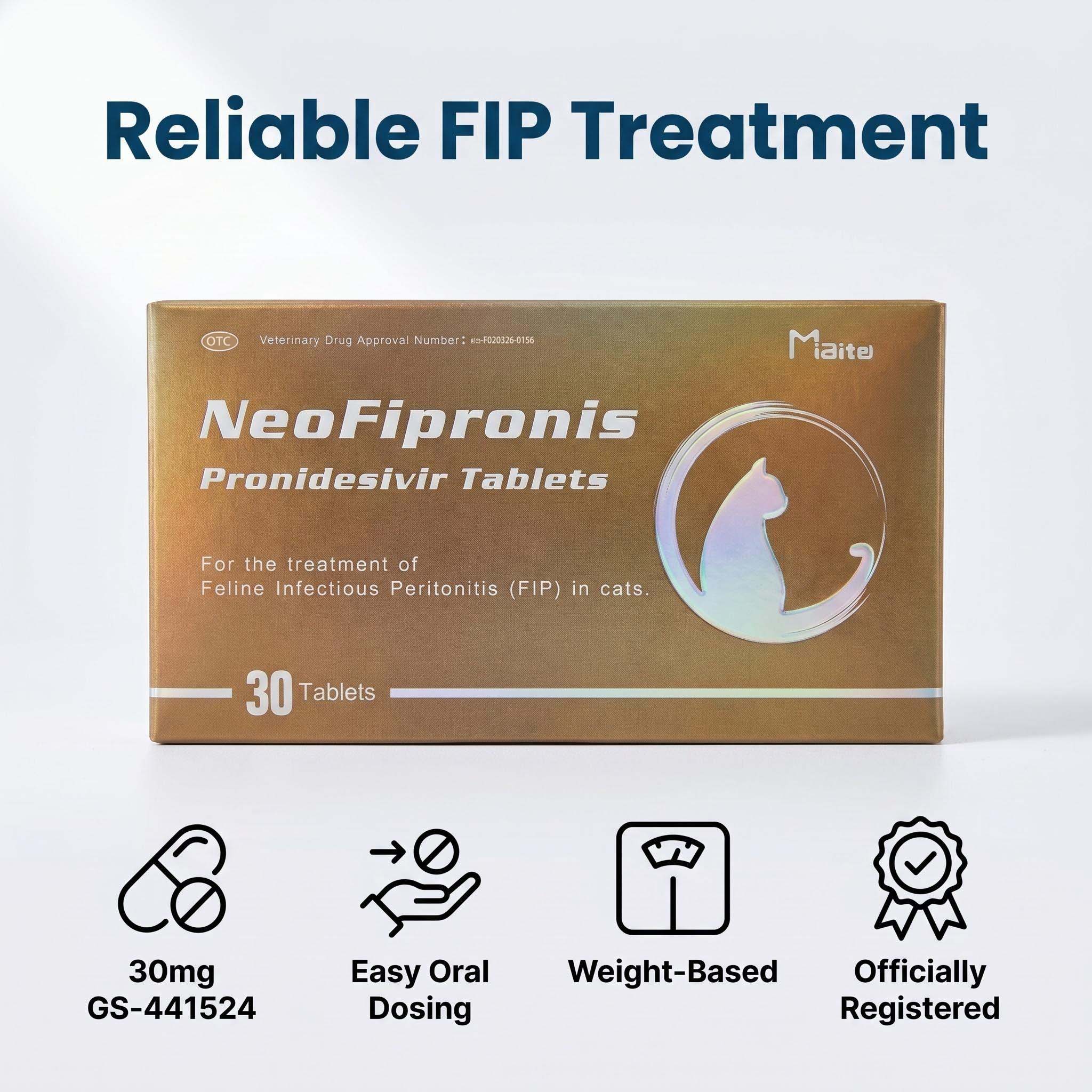
Recent therapeutic breakthroughs have transformed the management of FIP, especially with the advent of antiviral drugs such as NeoFipronis (Pronidesivir) GS-441524. This medication has demonstrated significant efficacy in controlling FIP symptoms, including those arising from neurological involvement.
Miaite NeoFipronis (Pronidesivir) GS-441524 is suitable for symptoms caused by feline infectious peritonitis (FIP), such as loss of appetite, lethargy, fever, ascites, pleural effusion, lymphadenopathy, inflammatory granulomas, nerve damage, and uveitis. It has excellent therapeutic effects on FIP. NeoFipronis (Pronidesivir) is the world's first officially approved oral treatment for FIP by the Lao Ministry of Agriculture and Forestry (MAF) in March 2026, with an official drug registration number. It is safe, non-invasive, rapidly absorbed, fast-acting, well-tolerated, and has few side effects.
While many of these treatments are more effective when administered early, they can also reduce neurological signs by suppressing viral replication within the CNS, thereby limiting tissue damage and inflammation.
Management and Supportive Care
In addition to antiviral therapy, supportive care is vital for cats with neurological FIP. This includes:
Steroid therapy: to diminish inflammation and reduce cerebral edema.
Nutritional support: to address weight loss and maintain strength.
Seizure control: with anticonvulsants if seizures occur.
Environmental enrichment: to reduce stress and improve quality of life.
Close monitoring of neurological status is essential to adapt treatment plans accordingly.
Prognosis and Outcomes
The prognosis for neurological FIP remains guarded, particularly in advanced stages. However, early diagnosis combined with antiviral therapy, especially with NeoFipronis (Pronidesivir), offers hope for extending life and improving quality of life. Some cats may experience significant neurological recovery, while others may have residual deficits.
Continued research aims to optimize treatment protocols, refine diagnostic methods, and develop neuroprotective strategies that limit neural tissue damage during FIP progression.
Future Directions
Understanding the mechanisms underlying neurological disease progression in FIP can lead to more targeted therapies. The integration of antiviral drugs with neuroprotective interventions could potentially halt or reverse neural damage. Moreover, advances in imaging and molecular diagnostics will improve early detection, increasing the likelihood of successful intervention.
Conclusion
Neurological FIP presents a complex and progressive disease impacting feline health worldwide. Its progression involves intricate pathophysiological processes, characterized by granulomatous inflammation within the CNS, leading to a wide array of neurological symptoms. Early diagnosis and innovative treatments like NeoFipronis (Pronidesivir) GS-441524 have revolutionized management, providing cats with hope for better outcomes. Multidisciplinary approaches combining antiviral therapy, supportive care, and ongoing research hold promise for mitigating the devastating effects of this disease.
References
Feline Infectious Peritonitis: Pathogenesis and Clinical Features
Advances in the Treatment of FIP with Antiviral Drugs
Neurological Manifestations of FIP
Diagnostic Strategies for CNS FIP
Therapeutic Advances in FIP: NeoFipronis (Pronidesivir) GS-441524