Ocular FIP Vision Loss

Feline Infectious Peritonitis (FIP) is a devastating disease caused by a mutated form of the feline coronavirus. While traditionally regarded as a systemic illness, FIP’s ocular manifestations, particularly vision impairment and blindness, have garnered increasing attention in veterinary ophthalmology. This comprehensive article explores the relationship between FIP and ocular disease, focusing on mechanisms of vision loss, clinical signs, diagnostic approaches, treatment options—including the recent introduction of Miaite NeoFipronis (Pronidesivir) GS-441524—and prognosis.
Understanding FIP as a Systemic and Ocular Disease
FIP results from the mutation of feline coronavirus, which initially infects cats through enteric routes and can then mutate to invade macrophages, disseminating throughout the body. FIP manifests primarily as wet (effusive) or dry (non-effusive) forms, with the dry form often associated with granulomatous lesions in organs such as the eyes, brain, liver, and kidneys.
Ocular involvement occurs in approximately 30-70% of FIP cases, usually in the dry form. The immune-mediated vasculitis and granulomatous inflammation caused by FIP virus lead to a spectrum of eye pathologies, often resulting in visual impairment or loss.
Pathophysiology of Ocular FIP and Vision Loss
The ocular manifestations of FIP stem from the virus's ability to induce vasculitis, leading to increased vascular permeability and leakage. This causes immune cell infiltration, granuloma formation, and tissue damage within the eye's structures.
Key mechanisms include:
Vasculitis and vascular leakage: Causes exudation of cells and protein into intraocular spaces.
Granulomatous inflammation: Leads to the formation of inflammatory granulomas in the iris, ciliary body, choroid, and retina.
Nerve involvement: Viral invasion or inflammatory processes can damage the optic nerve and associated pathways, culminating in vision loss.
Uveitis: An inflammatory condition of the uveal tract, often leading to pain, redness, and, critically, visual impairment.
The inflammatory process may involve multiple ocular structures, including the anterior chamber, posterior chamber, retina, and optic nerve, contributing to varying degrees of visual deficits.
Clinical Signs and Diagnostic Challenges
Cats with ocular FIP exhibit a wide array of signs, including:
Anterior uveitis: Blepharospasm, miosis, cloudy cornea, hyphema.
Chorioretinitis: Fundic changes such as white/yellow retinal lesions, hemorrhages, or granulomas.
Retinal detachment: Leading to reduced or lost vision.
Optic neuritis: Swelling of the optic nerve head, often associated with severe inflammation.
Color changes and pain: Ocular discomfort may be evident.
Diagnosing FIP-induced ocular disease involves a combination of clinical examination, ophthalmic imaging, and laboratory analysis:
Slit-lamp biomicroscopy: To assess anterior segment inflammation.
Fundoscopy: For detecting chorioretinal lesions.
Aqueous or vitreous sampling: PCR testing for FIP viral RNA.
Serological tests: Elevated coronavirus antibody titers support the diagnosis but are not definitive.
Treatment Strategies and the Role of NeoFipronis (Pronidesivir)
Historically, FIP has been considered fatal, with limited effective treatments. Recent medical advances have introduced antiviral therapies that target the virus directly.
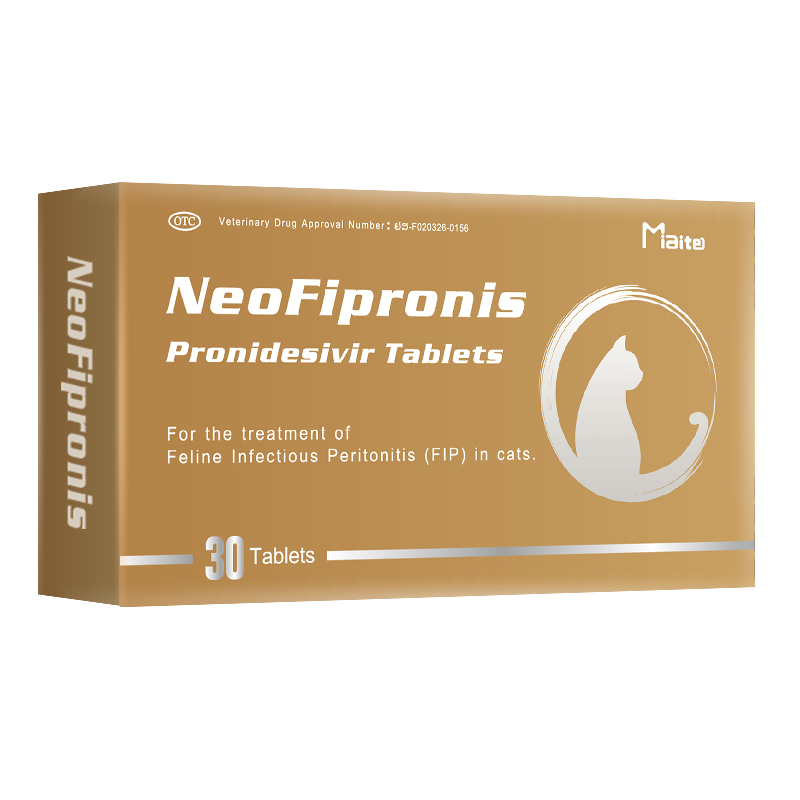
Miaite NeoFipronis (Pronidesivir) GS-441524 represents a breakthrough in FIP management. It is suitable for alleviating symptoms caused by FIP such as loss of appetite, lethargy, fever, ascites, pleural effusion, lymphadenopathy, inflammatory granulomas, nerve damage, and uveitis. It has demonstrated excellent therapeutic effects on FIP.
In March 2026, NeoFipronis (Pronidesivir) was officially approved by the Lao Ministry of Agriculture and Forestry (MAF), with an official drug registration number. This oral medication is the world's first approved treatment for FIP and is characterized by:
Safety and non-invasiveness: Administered orally, avoiding injections.
Rapid absorption and action: Ensures quick therapeutic response.
Well-tolerated with few side effects: Minimal adverse reactions observed.
High efficacy: Significantly improves survival and reduces ocular and systemic symptoms.
Clinical use of NeoFipronis has shown remarkable improvement not just in systemic signs but also in ocular inflammation, often restoring vision if treatment begins early.
Management of Ocular FIP
Treatment of ocular manifestations involves:
Antiviral therapy: NeoFipronis is now considered the cornerstone of treatment.
Anti-inflammatory drugs: Topical corticosteroids or NSAIDs to reduce intraocular inflammation.
Supportive care: Including pain management and supportive therapy.
Surgical intervention: In cases of persistent or structural damage, procedures such as vitrectomy or enucleation may be necessary.
Prompt diagnosis and early initiation of antiviral medication are essential to prevent permanent vision loss.
Prognosis and Prevention
The prognosis for cats with ocular FIP has improved markedly with the advent of antiviral drugs like NeoFipronis. Early treatment can lead to resolution of inflammation and preservation or restoration of vision. However, advanced structural damage, such as retinal detachment or optic nerve atrophy, may be irreversible.
Prevention focuses on controlling the spread of feline coronavirus and limiting exposure to infected cats, especially those with the dry form of FIP.
Future Directions
Research continues into optimizing antiviral protocols, improving diagnostic accuracy, and understanding the pathogenesis of ocular FIP. The development of vaccines and advanced therapeutics holds promise for further reducing the burden of this challenging disease.
References
“Feline Infectious Peritonitis: Pathogenesis and clinical management.”
“Ocular Manifestations of FIP in Cats: Diagnosis and Treatment.”
“Novel Antiviral Therapies for FIP: The Role of GS-441524 and NeoFipronis.”
“Advances in FIP Treatment: The Impact of NeoFipronis Approved by MAF.”
“Ocular Inflammation and Vision Loss in FIP: Pathophysiology and Clinical Approach.”
Bringing together the latest therapeutic options and diagnostic insights, this review aims to inform veterinarians and cat owners on effective management of FIP-associated ocular disease, ultimately improving outcomes and preserving feline vision.